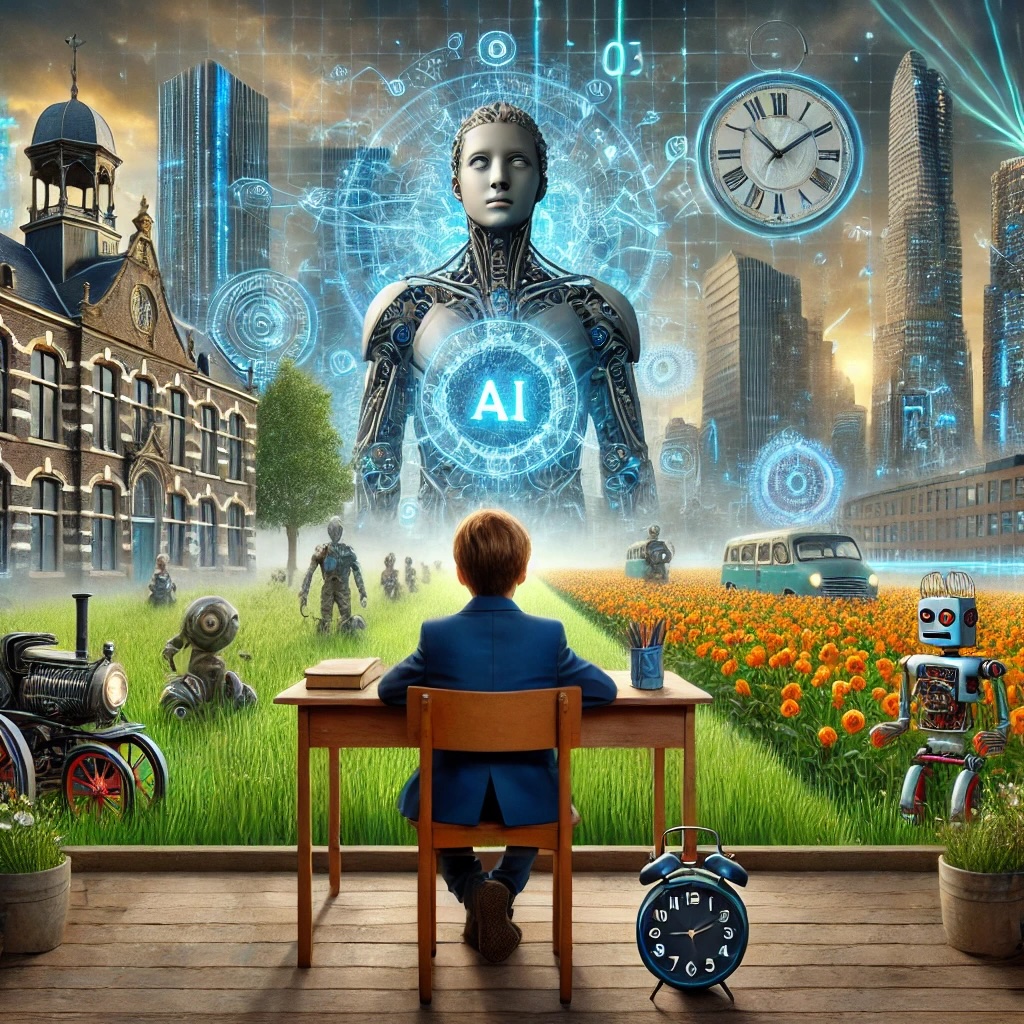
1. Technological leaps
From GPT-3 to the next AI revolution
AI doesn't develop in small steps, but in artificial giant leaps. In 2020 OpenAI introduced GPT-3, a model that could already generate impressive text. Less than three years later came GPT-4, producing essays, code and even medical analysis at a high level. Now we're on the eve of the next leap: OpenAI's o3 model has shown impressive reasoning ability, with performance that on certain benchmarks matches or beats the human level.
Meanwhile AI isn't just getting smarter, it's physically entering the world. Self-driving cars are no longer a distant dream, they're already being tested in cities around the globe. Humanoid robots, like the ones from Figure AI and Tesla's Optimus, keep getting more advanced and could take over simple tasks in factories and shops in the near future. Tesla plans to produce a few thousand units by the end of 2025, which could be a first step toward large-scale integration of AI-driven robots into the labour market. That raises fundamental questions about the future of work and the role of human labour in a world where machines can do more and more.
What counts as advanced today is outdated tomorrow. AI models that were seen as revolutionary a year ago get overtaken within months by new versions with exponentially better performance.
"How do we prepare for technology that moves so fast that most people barely understand what's happening?"
This question is more urgent than ever. While governments and companies struggle to shape policy and regulation, AI keeps thundering on. Legislation always lags behind technological change, but with AI we risk falling behind not by years but by decades.
What does it mean for society if policymakers lose control over technologies that can affect all our industries and jobs? How do we build laws, ethical frameworks and education programmes if the conversation has barely even started?
2. The gap between the AI bubble and the rest of society
Even though AI is developing at breakneck speed, people live in two completely different worlds. On one side is a group that fully embraces AI and uses it daily, while on the other side a majority barely knows what AI really is or how it's changing their lives.
The gap keeps growing, and that worries me. Anyone who digs into AI sees the exponential progress and the impact on almost every part of society. But anyone outside this bubble hardly notices, until suddenly it's too late to adapt.
Wietse Hage's four AI groups
On the AI Report podcast (formerly Poki 😉), Wietse Hage and Alexander Klöpping discuss the latest AI developments every week. In one of the recent episodes Wietse voiced his concern about how fast AI is developing, and argued that governments may need to hit the brakes. He named four main groups people fall into when it comes to AI:
- Business-as-usual group: People who see AI as a handy tool, comparable to a smartphone. They accept that AI is useful, but don't believe it fundamentally changes the world.
- Business-as-usual-plus group: People who do see that AI is developing extremely fast, but don't yet take the impact fully seriously.
- Disruption group: People who see AI as a revolutionary technology, comparable to the internet. They see far-reaching consequences for work, geopolitics and society.
- The devoted group: People who believe AI will soon completely surpass us, with existential consequences.
Most people are still in the first two groups. And probably a lot of policymakers too, while ideally they'd be in the disruption group. In practice governments and companies often lag behind, partly because of slow legislative processes and partly because of a lack of technical knowledge. As a result, regulation may be running decades behind the breakneck pace of AI.
My own place in this gap
Although I place myself mostly in the disruption group and worry about the speed and impact of AI, I'm also hugely enthusiastic about the technological progress. AI shows how innovation can speed up processes, spark creativity and open up possibilities that were unthinkable a few years ago. I try out nearly every new tool, follow the latest developments and experiment with AI in my work to make processes more efficient.
Still, I often end up in discussions with people who see AI as "just a handy tool". This became painfully clear during a conversation with a young colleague, who said:
"Yeah, ChatGPT is going to change our jobs. And AI too, I've heard."
When I explained that ChatGPT is itself AI, she looked surprised. That moment sums up exactly where my worry lies: a lot of people don't understand the basics of AI, let alone the enormous impact it will have on work, education and our society as a whole.
I don't see AI as a purely negative force, but as a tool that, used and guided well, can play a crucial role in work, education, healthcare and tackling big societal challenges like labour shortages, the energy crisis and climate problems. I even believe AI can eventually help solve humanity's biggest problems, simply because in ten years it will be exponentially smarter than we are.
At the same time, the gap between AI-native users and the rest creates a risk of uneven adoption. Early adopters, like me, already notice how big that head start is. That brings a strange tension with it: on one hand I'm fascinated and excited about everything that's possible, on the other I feel a growing unease about the gap that's forming.
💡 What does this mean for the gap?
Just as the digital revolution created a split between the 'internet-literate' and the 'digitally illiterate', AI is leading to a divide between people who use the technology daily and the rest.
The question remains: does AI stay a tool for everyone, or does it become an exclusive instrument for an elite that knows how to use it?
3. Art and culture as reflection and solution
Art as a mirror of AI
My background as a photographer, artist and student at the Fotoacademie taught me how art can be a mirror, both personally and socially. As I dug deeper into the impact of AI, I wondered why this conversation stays so confined to tech circles. Why do so many people not seem to realise how big these changes are? The exhibitions on digital art and AI that I visited only strengthened that feeling.
One of the works that struck me was The Future of Something by Jonas Lund. This piece explores how technology affects human fears, authenticity and creativity. It shows how people struggle in a digital world where human interaction is increasingly replaced by AI. During the exhibition I saw something I often miss in the public debate: a deeper reflection on what AI does to us.
Why art helps us understand AI
Art offers a way not just to understand AI, but to experience it. Discussions about AI often revolve around technical aspects, ethical dilemmas and regulation, but art touches a deeper level: the emotional and the intuitive.
Imagine schools not only teaching AI classes, but also organising mandatory museum visits to exhibitions about technology and the future. Not as dry explanation, but as a way to feel where we're heading.
For policymakers too, art can offer an accessible angle. Maybe politicians don't need deep technical knowledge, as long as they understand the impact of AI. A work like The Future of Something can show them intuitively what AI does to us. A mandatory museum visit for the cabinet might sound absurd, but it could easily set off a snowball effect.
Art as a mirror of technological power
During my visit to Calculating Empires, a data visualisation project by Kate Crawford and Vladan Joler, I was confronted with how art not only explains technology but also reflects on the entanglement of power, resources, labour and data. The printing press, the steam engine and the internet didn't just change the economy, but also the way we think and distribute power. AI repeats this pattern, but with a speed and impact we can't yet fully grasp.
💡 Question: What does it mean when AI takes over not just work, but also strategic decisions, creative processes and maybe even legislation? Who decides the direction we go in then?
Concrete proposals
- Make art more accessible: Provide free museum access for young people, so they come into contact with art about AI and technology.
- Make AI exhibitions part of education: Integrate these exhibitions as a full part of the curriculum.
- Art as an awareness tool in politics: Let policymakers consult not only AI experts, but also artists and philosophers who map the societal impact of technology.
💡 Core message: Art shows us what can't be captured directly in numbers. And that's exactly what we need in a time when AI changes faster than we can keep up.
4. AI in historical perspective
Every technological breakthrough has changed the world. The printing press democratised knowledge, the industrial revolution replaced physical labour, and the internet globalised communication. AI is often placed in the same row, but it's fundamentally different: it changes not only what we do, but also how we think, learn and work.
Why is AI different?
- Printing press: Spread knowledge, but didn't directly change who held power over information.
- Industrial Revolution: Replaced muscle power, but human thinking was still needed.
- Internet: Sped up communication and brought people together, but gave tech companies enormous influence.
- AI: Can not only take over existing tasks, but also learn, decide and manipulate information on its own.
The biggest challenge is that we don't know how fast, or in which direction, AI will develop. In earlier revolutions we had decades to adapt, but AI develops exponentially. What's new today is outdated tomorrow.
How do we deal with this?
The question isn't whether AI will have an impact, but how we deal with it. Should we slow everything down? Or should we prepare ourselves better?
💡 Concrete solutions:
Raise awareness: AI shouldn't stay a black box; society needs to understand what's happening.
Adapt regulation to the speed of innovation: Laws shouldn't only follow once the damage is already done.
Reform education drastically: Young people shouldn't be trained for jobs that soon won't exist.
Encourage AI literacy: Everyone should have a basic understanding of how AI works and what the consequences are.
Where earlier technologies helped people become faster, stronger or smarter, AI could usher in the moment when humans are no longer necessary to carry out crucial tasks. That's a future we can't passively wait for, we have to shape it now.
5. Education in 2027: a time traveller looks around
Education lags behind in an accelerating world
While AI develops at breakneck speed, the education system stays stuck in methods that have gone unchanged for decades. Young people are being trained for a world that no longer exists. At the same time I realise that some basic skills, like mental arithmetic and factual knowledge, are essential for cognitive development and critical thinking.
But let's be honest: the current education model barely prepares young people for the AI future. We keep clinging to a system where everyone learns the same thing, at the same pace, and where a student is judged on reproducing knowledge that AI can generate in a fraction of a second. Where are the subjects that are really needed in an AI-driven society?
I see the slowness of the system in my own children too. My seven-year-old son already works on a laptop, but the way he's taught barely differs from ten years ago. The core of his education is still aimed at standard knowledge and fixed teaching methods, while the world outside the classroom changes at lightning speed.
The time traveller in the classroom
Imagine: a child from 2030 accidentally walks into a classroom in 2024. Their world consists of AI mentors, augmented reality glasses that give real-time explanations, and a personalised learning path where they only get the material they haven't mastered yet. But in the classroom of 2024 you see students memorising lists of capital cities and writing mathematical formulas on paper. The teacher stands in front of the class, while every student follows the same lesson at the same pace, regardless of personal talents or learning needs.
The time traveller frowns:
"Why are they still learning here the way they did fifty years ago?"
While the rest of the world adapts to AI, education looks like a time capsule where technology barely plays a role.
What does the classroom of the (near) future look like?
We shouldn't stay stuck in theory, but offer concrete solutions. Below are five radical but achievable changes that make education fit the AI future:
- 🚀 AI mentors as teaching assistants: AI helps teachers by monitoring individual progress and gives students personal guidance. That way students can work at their own pace and get extra support right where they need it.
- 📚 A more flexible education model: Young people should get more freedom to choose the subjects they want to go deeper into. AI can help discover where their talents lie. New subjects like technology ethics, AI literacy and mindfulness get a place in the curriculum this way.
- 🎬 AI education through film and interactive media: Films like Ex Machina, Black Mirror, Blade Runner and Her can be used to make ethical AI dilemmas tangible. Students get assignments where they reflect critically on the role of AI in society.
- 🕶 Learning with AI and VR simulations: Instead of dry theory, students get real-life scenarios to solve with AI. AI-generated cases, like legal simulations or medical diagnoses, make the material more relevant and tangible.
- 💡 AI as a tool for teachers, not a replacement: AI can support teachers with lesson prep and admin tasks, but the human side of education, like collaboration, creative thinking and discussing ethical questions, stays essential.
What's already happening in Dutch education?
Although AI is starting to play a role, the system stays largely traditional. There's no national AI policy for secondary education yet, but a few initiatives exist:
- Het Coornhert Gymnasium (Gouda): Testing AI-based teaching material.
- Gynzy and Learnbeat: Learning platforms that adapt exercises to students' learning needs.
- National Education Lab AI (NOLAI): Researching how AI can improve education.
💡 Conclusion: AI is coming, but Dutch education is far from ready.
Concrete proposals: the buttons we need to press NOW
- AI literacy as a mandatory subject: Everyone should understand what AI is and how to use it critically. Just as digital literacy is now required, AI literacy needs a fixed place in the curriculum.
- A more flexible and personalised education model: Students should learn at their own pace and their own level, supported by AI.
- AI as an assistant for teachers, not a replacement: AI can take over repetitive tasks, but human interaction and guidance stay crucial.
- Integrate technology, ethics and critical thinking into ALL subjects: AI touches all of society; it shouldn't just be an elective for IT students.
- Make education proactive: We need to invest in experiments and pilots now, so we don't end up chasing the facts.
The time traveller from 2027 looks around once more. They see a class where students don't just consume, but also create with AI. Where technology isn't only used to get tests done faster, but to solve real problems. The education they're used to differs drastically from what we see now.
💡 The question: How do we make sure education keeps up with AI, instead of falling behind?
6. Jedi wisdom in a world of AI
What do we lose when everything becomes effortless? We live in a world where technology keeps making our lives easier. AI helps us make decisions, algorithms predict what we want to see, and with one click everything is within reach. But if everything becomes effortless, what do we lose?
We lose focus, resilience and the ability to deal with discomfort. AI takes over more and more of our thinking, and that feels nice, until we no longer know how to solve something ourselves. I notice this personally. Why would I structure a text if ChatGPT can do it for me? Why would I search for information myself if AI can summarise it?
That convenience sounds ideal, but paradoxically it can actually make us more dependent. If AI relieves us of too much, we slowly lose our problem-solving ability.
"Convenience is addictive. But not everything that's easy is good for you."
We have to learn to use technology consciously and with intention, otherwise we become passive consumers instead of active thinkers.
The Jedi as a model for digital balance
In Star Wars the Jedi aren't just fighters, they're also philosophers. Their training is about focus, discipline and balance. They learn to deal with temptation, with their emotions, and with the idea that real strength doesn't come from control, but from awareness.
Those principles are relevant in a time when we're constantly distracted by technology. Instead of making conscious choices, we let algorithms decide what we see, what we buy and even how we feel. The convenience society pushes us to take the fastest and easiest route, but is that actually good for us?
I notice it in myself: I sit behind my computer for days on end, constantly check my phone, and get tangled up in AI tools, while my kids actually need my attention. I'm no saint, but I feel that this doesn't always make me happy. A lot of people, especially young people, feel that deep down too.
Sometimes struggle is good. Sometimes it's better not to always take the easy way. You don't learn anything from constant instant gratification, from using technology to avoid obstacles. Maybe that's also why programmes like Kamp van Koningsbrugge (a Dutch military-endurance TV show) are so popular: because deep down people know that a bit of discomfort and challenge makes them stronger.
The Jedi understood this already. In a world where AI becomes ever more dominant, we shouldn't only develop smart technology, but also stay smart, conscious people.
7. From writer to pilot to passenger?: reflection and closing thought
When I started this essay, I was sure of one thing: I wanted to make a well-founded contribution to the discussion about AI. What I didn't expect was that AI itself would play such a big role in creating this text.
This essay was written with the help of AI, but not by AI. I didn't use AI as a machine that thought for me, but as a sparring partner that sharpened my thoughts, tightened my arguments and broadened my knowledge. My writing style is sometimes less fluent and my sentences can be chaotic, but AI helped me filter out the noise. In the end the direction stays entirely with me. Without AI this essay would look different, and without my own thinking it would never have existed.
7.1 AI as an accelerator, not a replacement
While writing I used tools like Google Deep Research and Google NotebookLM to search faster through huge amounts of information. I loaded and analysed privacy documents from OpenAI's security portal to better understand how AI is regulated. While AI helped me structure and organise information, I had to make the interpretations myself. What does this mean for the future? How do I make sure my argument aligns with my personal vision? No AI model could answer those questions for me.
7.2 Wietse's call: what now?
This question applies not just to writers and artists, but to everyone. AI changes how we work, learn and even how we think. If we're not careful, we go from critical thinkers to passive users. The pace of AI development forces us to think about how much control we still want, and can, keep. AI can strengthen us, but only if we choose to stay at the wheel ourselves.
🚀 Do we stay pilots, or do we become passengers in our own creative process?
On the Poki podcast (now AI Report), Wietse Hage called on people not just to complain about AI, but to come with concrete ideas. I fully agree. It's time not only to understand AI, but to actively steer it.